Thursday, January 16, 2014

The Golan Heights

Day 5, Tuesday, January 14, 2014

Our cottage by the sea at Ein Gev Kibbutz.


We visited a partially reconstructed village dating to the 2nd century AD named Katzrin in the Golan Heights.  It is considered an active village.  They are farming and raising sheep.  Today we ground olives and ate bread baked here.

A mosaic at the entry.


Avi Noam, the director of the site showed us how to grind olives.


We went inside a reconstructed house with a loft bedroom.

An oil lamp was our light.


The ceiling caused us to think about the man lowered through the roof that Jesus healed.  My thoughts also went to the stories of Mary and Martha with Jesus in their home and how that would have felt.  So many of the stories in the Bible are in a home.


This is the outside courtyard and cooking area - Considered a luxury today!


We were treated to fresh baked pita with cheese, preserves and olive oil.


One of the ladies demonstrated spinning and weaving with wool from the farm as it would have been done in Proverbs 31.


We completed our time sitting in the synagogue discussing how our culture has moved away from community and what we need to do to raise our children in and live in community that transmits our values.

Mt. Bental

Mt. Bental and Mt. Arvital are located on the Israel/Syria border.  At one time, they both had active military bunkers.  Today Mt. Bental is open to tourists.  This is the view from the top looking over Syria and the UN border camp.  The cultivated fields are in Israel.  The rest is Syria.  Our guide, Ronen, did a wonderful job telling us about the 6 day war when the Golan Heights were taken back by Israel.  Currently, the border is delineated by mountains.


The entrance to the bunker.


Inside one of the rooms.


Caesaria Philippi

We hiked a trail up to Caesaria Philippi that ran along the river and had beautiful waterfalls and foliage.  It was cool and refreshing and a pretty good hike.  This is the ancient city at the base of Mt. Herman on the road to Damascus where we know from Mathew 16 that Jesus and the disciples traveled.  From here it is 110 miles to Jerusalem and 140 miles to Damascus.  It was a first century center of Paganism with temples to Zeus, Pan, and Caesar Augustus.  Pan was a fertility god who was half man and half goat.  The water that comes out of the cave here is a spring that is the headwaters for the Jordan river.  It was believed that this cave was an entrance to the underworld, Hades.  In Matthew 16, Jesus and the disciples come here.  Jesus asks who they say He is and Peter answers that He is the Christ, the son of the living God.  Jesus says to Peter that it is on this rock that He will build His church and the gates of hell will not prevail against it.  Was he referring to this place physically or metaphorically?  Maybe both..... Caesaria Philippi and Pan and Caesar are all gone.


Terry at the gate to Hades!


Niches for monuments to the gods.


The cave of the spring.


Tel Dan

There's a very large archaeological excavation at the site of the city of Dan.  It was a city long before the Israelites were there and was improved and became a holy city for the northern Israelites after the kingdom was divided in the 9th century BC.  This is city gate from that time.


But most interesting is this site of a temple or place of worship found that dates to Israelite times.
It matches the measurements for the temple and the locations of the worship elements as prescribed in the Bible almost perfectly.  The bones found also strongly indicate a Hebrew temple.  Since we aren't likely to ever excavate the Temple in Jerusalem (it has a mosque built over it), this is most likely the closest we have or will come to seeing the Temple.  


The back side of the excavation at Dan is the border with Lebanon.


This is a mud brick gate also found at Tel Dan and currently being worked on.  It dates to 1800-2000 BC (the time of Abraham) and is the largest we have found in the world.  Remember that Abraham chased Lot's kidnappers to Dan.


Goodbye Kibbutz on the Sea of Galilee!


Goodnight moon.


Bet Shean/Scythopolis, Megiddo, Caesarea

Day 7, january, 15, 2014

Bet Shean/Scythopolis

Bet Shean was an Israelite settlement that eventually became the Roman town of Scythopolis.  It was a grand city with streets lined with columns, a large bath house, theater and much more.  It was the New York City of Israel in Jesus' time.  It was destroyed by an earthquake in the 8th century so it remains trapped in time under a layer of debris. This huge city is still being excavated but what is uncovered now is huge.


The original stone streets are intact.


Beautiful mosaics were uncovered.


And unbelievable marble and granite that tops much of the limestone.

The largest Roman bath house found is here.  They heated the bottom of the pool including the stone stumps and then water is poured over it to make a steam bath.  They steam cleaned their bodies since daily showers and soap were not around.  They also had some interesting stone bathrooms!


Much of the theater is intact.

The theater seating.


Incredible acoustics for a song by Caitlin and a sweet time of worship.

Mt. Carmel

The site where the god contest was held in 1 Kings 18 with Elijah, Ahab and Baal.
This is an incredible view across the Jezreel Valley.  Randy shared thoughts with us about how this experience in Israel affects our ministry.  "You can be Jewish without Christianity but you cannot be Christian without Judaism."


We should all have such a backdrop when we speak!


Caesaria

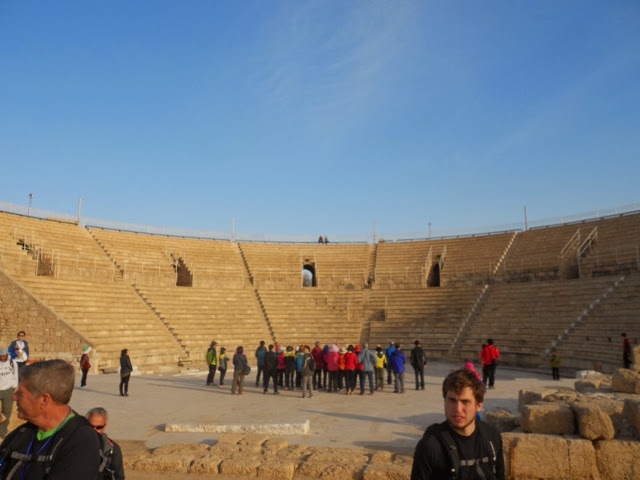
Built by King Herod on the coast of the Mediterranean as the largest port in Israel and one of the largest in the world, the site at Caesaria has only been excavated in the last 20 years. It has a theater that seats 4-5000 and is still in use, a hippodrome and the remains of a palace and seaside, freshwater swimming pool as well as a massive aquaduct system.  The hippodrome, built for chariot races,  held 10,000 spectators and was 200 yards long.  Herod held an "Olympics" at Caesaria.  At that time, if you won first place in Athens, you got a laurel wreath.  At Herod's Olympics in Caesaria, first place got a gold medal, second place - silver and third place - bronze.  Sound familiar?

The theater.


The hippodrome is in the forefront.


The square hole is where the freshwater swimming pool was.


Mosaics still on the pool deck area.


Interesting first century restrooms at the hippodrome.


The aquaduct miles down the beach.


Sunset on the Mediterranean.


Jerusalem tomorrow!


Tuesday, January 14, 2014

Sea of Galilee, Mt Arbel, Capernaum, Chorazin & Bethsaida

Day 4, Monday, January 13, 2014

Boat Ride on the Sea of Galilee

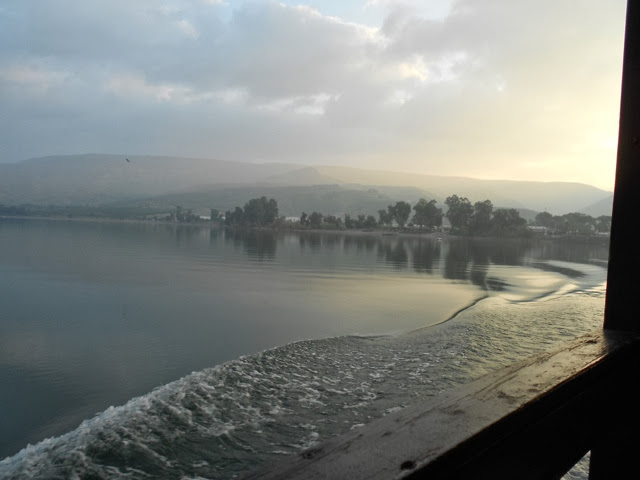
We began our morning with a boat ride across the Sea of Galilee.  We are staying in a Kibbutz (community) on the east side of the Sea directly across from Tiberius in Ein Gev.  We boarded the boat at the Kibbutz first thing after breakfast.  It was a revelation to me that this "sea" is really a lake.  Much like lakes in Oklahoma.  From anywhere on the lake, you can still see the shore.  Fortunately for us, it was a calm morning.


After some time to digest where we were and ponder the idea of being on the Sea of Galilee, the party began!  We started with the Star Spangled Banner and the Israeli National Anthem and moved on to Hava Negilah then other dancing music.  I could start every day with a party like this!


Mt. Arbel

After a steep mountain climb or a bus ride through Tiberius, we all arrived on the top of Mt. Arbel.  It was hazy and the view was still spectacular.  Looking down you could see the Sea of Galilee, a muslim village with a mosque and the town of Magdala as well as the city of Tiberius.  It was pretty amazing to enjoy some quiet time on the mountain.

Mark 1:35 "Very early in the morning, while it was still dark, Jesus got up, left the house, and went off to a solitary place, where he prayed,"


Town of Capernaum

The town of Capernaum where much of Jesus' ministry took place is now owned by the Catholic church.  It has been excavated and contains:  the ruins of the village, what is thought to be Peter's house and a 1st century synagogue (in basalt stone) with a 4th century synagogue (built in limestone) built on top.


Chorazin

The town of Chorazin has been excavated.  It contains houses, an olive press  and a synagogue.  Here is a manger in one of the houses.


Bethsaida
The New Testament town of Bethsaida was probably in the same place as the Old Testament town of Gesher.  One of King David's wives was from Gesher and their son, Absolom fled to Gesher. In the oldest excavations, there is a 4 chambered gate.  It is one of the first examples we have.  Next to the gate is a monument to a god with a bull's head.  Inside, there is also an altar apparently for burnt offerings.  Is this a Hebrew village?  The ruins of Bethsaida appear to be closer to the river and on top of the older settlement.  This is a large site and still under excavation.


Next....Tel Dan, Katzrin, Mt. Bental, Caesaria Philippi,